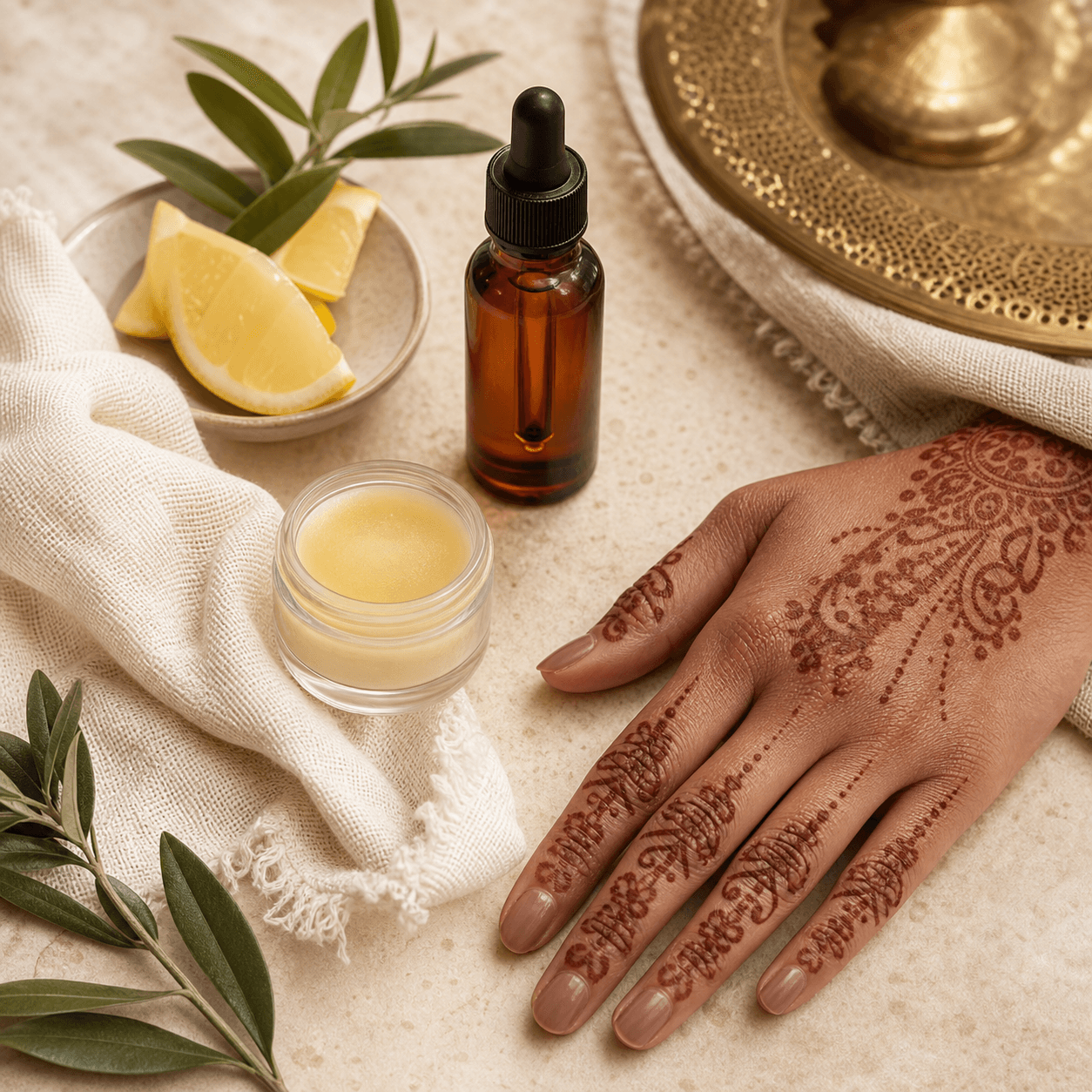
The most important fact about natural henna aftercare is simple: the color is not finished when the paste comes off. A genuine henna stain commonly appears orange at first and develops toward brown or reddish-brown over the next day or two.
That gradual change is normal. It also helps distinguish realistic natural-henna expectations from products that promise an immediate jet-black stain. The FDA notes that henna typically produces brown, orange-brown, or reddish-brown tones; other colors require additional ingredients.
Henna stain timeline
While the paste is on
The visible paste is not the final stain. Application quality, the paste formula, skin location, temperature, and contact time can all affect the result. Follow the specific artist or product directions rather than a universal internet rule.
Avoid touching wet paste against clothing or furniture. Once dry, keep the design from cracking or rubbing away earlier than intended. Do not wrap it in a way that traps excessive heat or moisture unless the product instructions or a trained artist specifically direct that method.
Immediately after removal
The first stain can look surprisingly light and orange. That is not necessarily a failed application. Brush or scrape away paste according to the supplied directions and avoid aggressive rubbing.
If the product instructions call for washing, follow them. Advice differs because premixed cones and artist-made pastes can have different formulas. A careful seller should provide clear removal directions instead of relying on folklore.
The first 12 hours
The stain begins to deepen. Hands and feet often develop more strongly than areas with thinner outer skin, while frequent washing or friction can shorten how long a design remains visible.
Keep expectations flexible. Two people using the same cone can finish with different shades. Even on one person, fingertips, palms, wrists, and forearms may develop differently.
Around 24 hours
Many natural henna stains look noticeably browner than they did at paste removal. The design may still be developing. Photographing it in the same natural light is a better comparison than judging it under different indoor bulbs or filters.
Around 48 hours
The color is often near its mature appearance, although there is no guaranteed hour or shade. From this point, the stain gradually fades as the outermost skin cells shed.
Practical aftercare
- Follow the exact directions supplied with the cone or by the artist.
- Remove dried paste gently; do not pick at the skin.
- Reduce unnecessary soaking, scrubbing, and friction while the stain develops.
- Use gloves for cleaning tasks if detergents and repeated washing would otherwise contact the design.
- Avoid unlabelled “darkening” mixtures. An instant-black result is not the normal color path of natural henna.
- Keep the ingredient list, batch details, and seller information until you know the application caused no concern.
Aftercare can support a well-applied stain, but it cannot turn poor or stale paste into a predictable result. Claims that a trick will guarantee a specific color or number of days should be treated cautiously.
What controls the final color?
Body location
Areas with a thicker outer skin layer, especially palms and soles, often show deeper stains than forearms, shoulders, or the torso. A portfolio photo from a palm is not a reliable promise for a shoulder design.
Paste freshness and storage
Prepared natural henna is time- and temperature-sensitive. Buy from a seller who explains whether the cone is freshly made, frozen, refrigerated, or shelf-stable and who gives specific storage and use-by instructions.
“Fresh” is not enough information by itself. Look for a preparation or batch date, storage history, thawing directions, and a clear statement about whether a thawed cone can be refrozen.
Contact and application
An even line and suitable contact time help create an even stain. Very thin, broken, or prematurely removed paste may produce a lighter or patchy result.
Heat, water, and friction
Warm skin can influence development, while repeated washing, swimming, exfoliation, and rubbing can make a design fade sooner. Do not use unsafe heat sources or occlusive wrapping to chase a darker result.
Individual variation
Skin condition, routine, and natural renewal differ. High-quality henna still cannot guarantee identical results for every person.
When the result is not normal
A light orange stain is not automatically a safety problem. Burning, intense itching, swelling, blistering, open skin, or a rapidly worsening rash is different. Stop using the product, retain its packaging, and seek qualified medical advice. Severe or systemic symptoms require urgent help.
If a paste created an immediate black mark, ask for the exact ingredient list. Review the natural henna vs black henna guide and report a suspicious marketplace listing rather than applying the product again.
Planning your appointment
For a wedding, festival, or photography session, ask the artist when they recommend application based on their actual paste and your chosen body location. Build in development time instead of booking immediately before the event.
Before the appointment, confirm the ingredients, the paste removal method, how the artist stores cones, and what to do if irritation begins. For more preparation help, visit the henna guides and browse henna designs.
Frequently asked questions
How long does henna take to darken?
Natural henna usually starts orange and deepens over roughly the next 24 to 48 hours. Exact timing and shade vary by paste, body location, application, temperature, and individual skin.
Why is my henna orange after I remove the paste?
Orange is a normal early color for natural henna. The stain generally develops toward brown or reddish-brown rather than appearing at its final shade immediately.
Can aftercare guarantee a dark henna stain?
No. Aftercare can reduce avoidable fading, but it cannot guarantee a shade. Paste freshness, formula, application, body location, temperature, and individual variation all matter.
How long will a natural henna design last?
Many designs remain visible for about one to two weeks, but frequent washing, exfoliation, friction, body location, and application quality can make the duration shorter or longer.