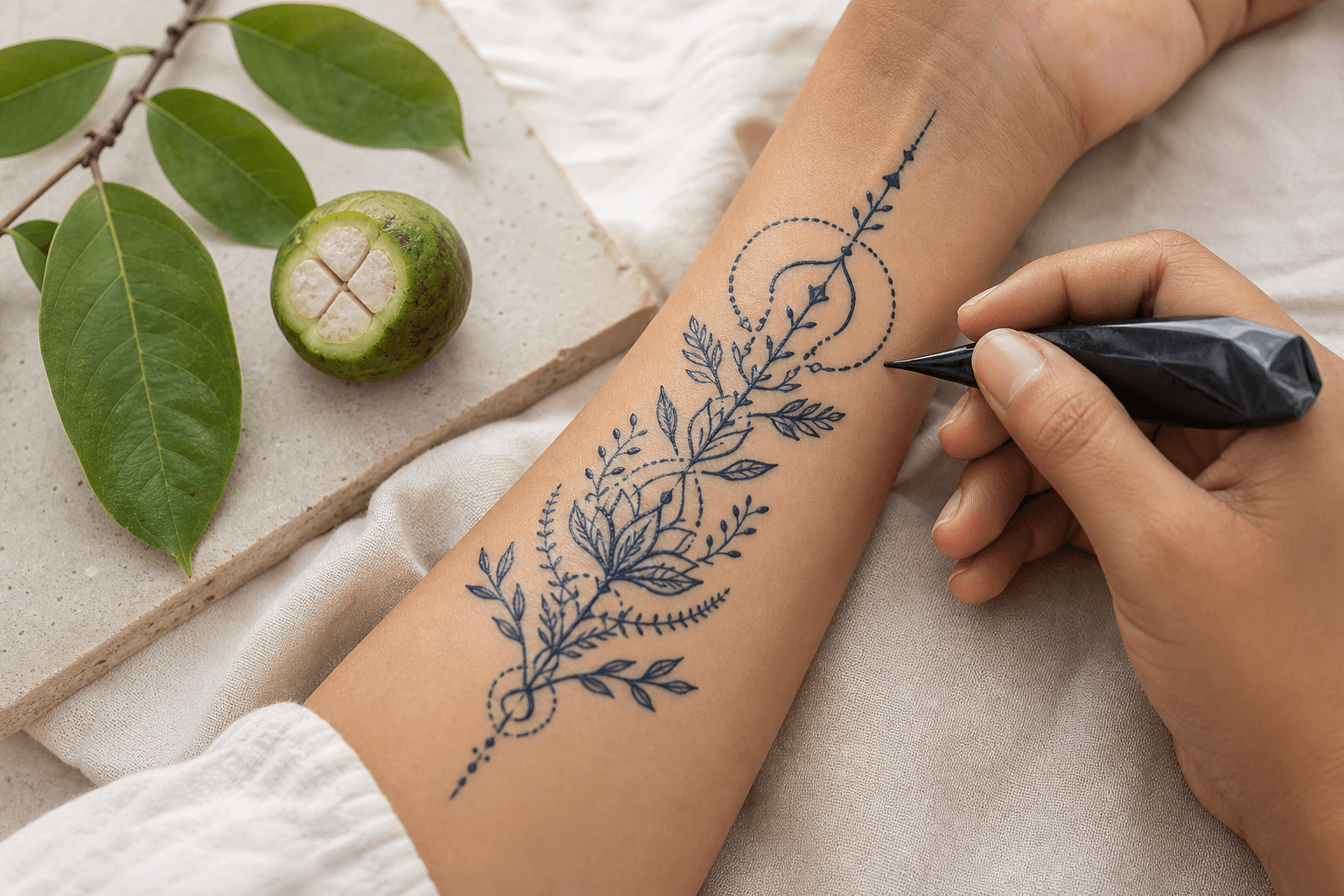
A jagua design often looks faint at first and develops toward a blue-black or dark navy appearance. It is not natural henna, and it does not follow henna’s orange-to-brown color path.
There is no single timetable that applies to every jagua gel. Formulation, body location, application, contact time, washing, friction, and individual skin all affect the result. Use the product’s own directions as the primary guide; use this timeline to understand the general sequence rather than as a guarantee.
What creates the blue-black color?
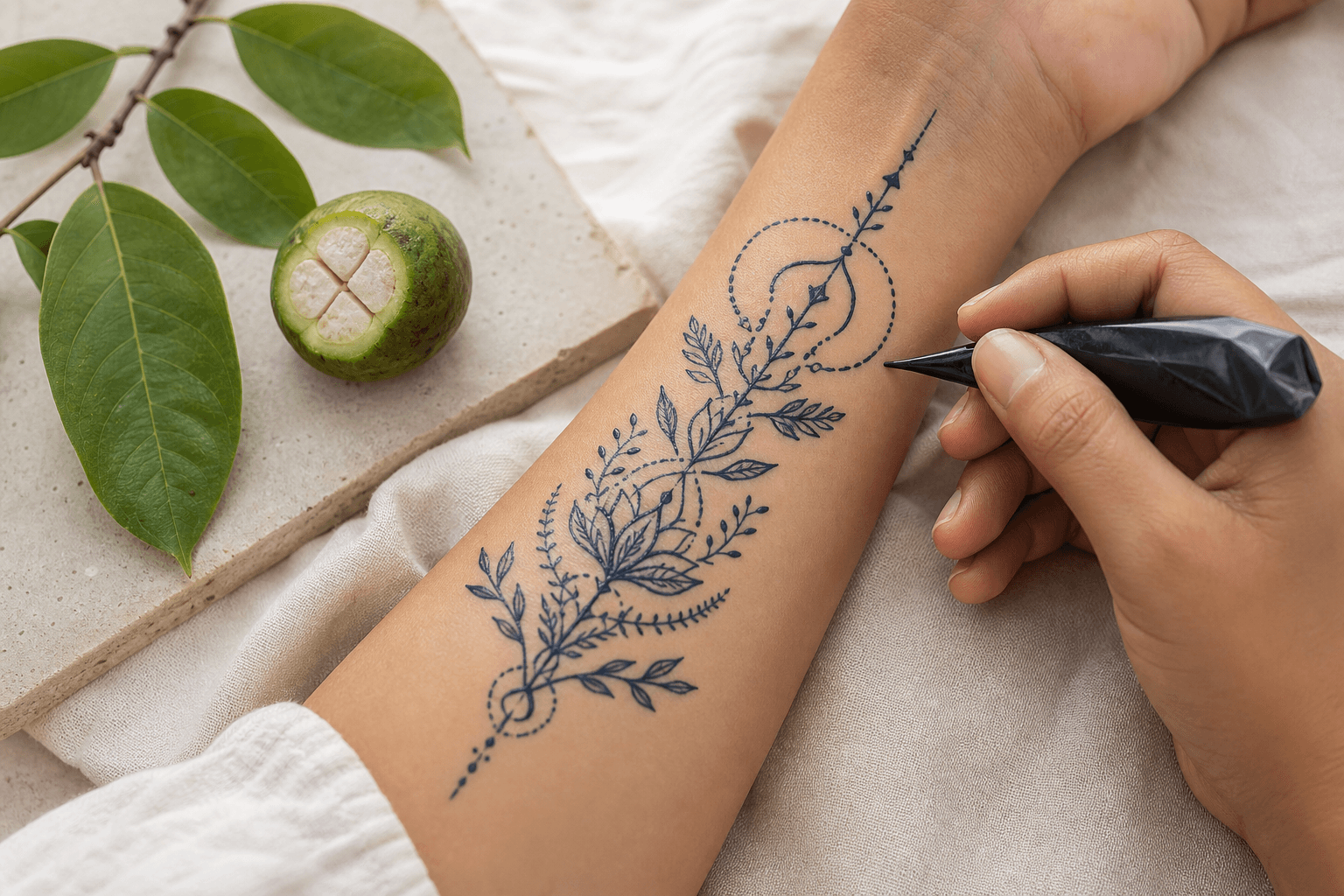
Jagua body-art colorants are associated with the unripe fruit of Genipa americana. Research on commercial henna and jagua products identifies geniposide and genipin as important jagua constituents. Genipin reacts with proteins to form dark blue pigments, which helps explain why the visible result differs from natural henna.
That botanical origin does not mean every bottle contains only fruit extract. Finished gels may include water, thickeners, preservatives, essential oils, colorants, or other ingredients. Read the complete ingredient list and the manufacturer’s directions.
Jagua is also not the same as a product marketed as “black henna.” Names and colors can be misleading, so identify the actual ingredients rather than assuming any blue-black temporary stain is jagua.
A practical day-by-day timeline

During application
The gel or juice sits on the outer skin in the chosen pattern. Avoid smearing it onto clothing or another body area. Follow the labelled contact time and removal instructions; leaving an unfamiliar formula on longer is not automatically better.
Immediately after removal
The design may be pale, grayish, or barely visible. Do not judge the final result at this stage and do not add an unlabelled “darkening” product. Photograph the area in neutral light if you want a useful baseline.
The first 12 to 24 hours
The color commonly becomes more visible as the stain develops. Different parts of one design can deepen at different rates, especially when line thickness, skin contact, or body location varies.
Avoid comparing your result with a heavily edited photograph. Phone processing, warm indoor lighting, and increased contrast can make a stain appear darker or blacker than it looks in person.
Around 24 to 48 hours
Many jagua products describe their stain as reaching a deeper blue-black during this period, but follow the exact product directions. A slower or lighter result is not automatically evidence of a safety problem.
If the design transfers to an unintended area while sleeping or while skin surfaces touch, it can create an extra mark. Keep the area clean and dry as directed and avoid tight contact that the maker warns against.
The following days
The stain remains in the outer skin and gradually fades as that skin renews. Hands may fade unevenly because of washing and friction; other areas may retain a more even design. Swimming, exfoliation, frequent cleansing, and rubbing can shorten the visible period.
Do not try to remove a stain with harsh chemicals, aggressive scraping, or unsafe home remedies. Time and normal skin renewal are the main fading process.
How long does jagua last?
Many sellers describe a visible period of roughly one to two weeks, but duration is not guaranteed. A product’s formula, the body area, skin routine, application, and friction all matter.
Ask the seller what its duration claim is based on and whether the photographs show the same formula. A responsible listing uses ranges and conditions rather than promising an identical result for every buyer.
Jagua aftercare without myths
- Follow the exact removal and aftercare directions for the specific product.
- Avoid unnecessary soaking, exfoliation, and friction if you want to preserve the design.
- Do not apply bleach, household chemicals, or unlabelled accelerators.
- Keep the packaging, ingredient list, batch code, and seller information until you know the application caused no concern.
- Photograph an unexpected reaction and the product label before discarding anything.
Aftercare can reduce avoidable fading. It cannot guarantee a shade, correct an unsuitable formula, or prove that a product is safe for every person.
Can jagua cause a reaction?
Yes, a botanical product can still cause irritation or allergy. A published case report identified genipin as the allergen in a person who developed allergic contact dermatitis after repeated use of a jagua temporary tattoo product. One case does not establish how common reactions are, but it disproves absolute claims such as “100% safe” or “allergy-free.”
Stop using the product if burning, intense itching, swelling, blistering, or a worsening rash begins. Remove it as directed, keep the label and batch details, and seek qualified medical advice. Breathing difficulty or severe systemic symptoms require urgent emergency help.
Do not use a home patch test as proof that a product can never cause a reaction. Follow the manufacturer’s directions and seek personal medical advice when you have a history of reactions or another reason for concern.
How to compare jagua products
Look for a complete ingredient list, responsible manufacturer, country of origin, batch code, preparation or expiry date, storage directions, contact time, removal steps, suitable body areas, warnings, and a clear support route.
Avoid listings that use only “natural jagua” as the formula, hide the label, promise a permanent result, or describe every blue-black stain as identical. Research has found substantial variation and incomplete labelling among commercial temporary tattoo products.
Use the jagua guides, compare natural henna and black henna, or browse jagua body art for related education.
Frequently asked questions
How long does jagua take to darken?
Many jagua products develop substantially over the first 24 to 48 hours, but timing depends on the formula, body area, application, and individual skin. Follow the product’s labelled directions.
What color should a jagua stain become?
Jagua is generally associated with a blue-black or dark navy stain. It is different from natural henna, which normally develops from orange toward brown or reddish-brown.
How long does jagua last?
A jagua design is often described as visible for roughly one to two weeks, but washing, friction, exfoliation, body location, application, and formulation can shorten or lengthen that period.
Is jagua allergy-free because it comes from fruit?
No. Botanical origin is not a guarantee against irritation or allergy. A published case report identified genipin as the allergen in a jagua product reaction.